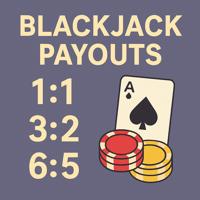
 Unlike most other casino games, blackjack offers you a real shot at beating the house especially if you use the correct strategy. However, there’s one piece of the puzzle that a lot of players sometimes overlook, which is the blackjack payouts.
Whether you’re new to the game or you consider yourself a regular, understanding how blackjack pays out is as vital as knowing when to hit or stand in the game. The difference between a good payout and a bad one might seem small at first instance but over time, it can seriously impact your bankroll.
So let’s break it down, shall we? Here’s a straightforward look at the different types of blackjack payouts you’ll come across and what they really mean for you.
1. Even Money or 1:1 Payout
When you play USA online blackjack, a regular win doubles your stake. This is a 1:1 payout, meaning that if you bet $10 and win, you win an extra $10 in profit giving you a total payout of $20. Also sometimes, when you have a blackjack hand and the dealer’s hand shows an Ace, you’ll get something called “even money.” This means you’ll get a 1:1 payout on your blackjack no matter what the dealer has.
While this sounds like a safe bet, it is not always in your best interest. This is because statistically, it’s better to wait and take the regular 3:2 payout unless you know the dealer has a strong chance of matching your hand.
2. The 2:1 Payout
It is not news that the iGaming industry is competitive and most casinos like to run special promotions to attract new customers, as you’ll see in our Las Vegas USA Casino Review. This has given rise to the 2:1 blackjack payout, although not so common.
With this, instead of the standard 3:2 reward for your blackjack hand, these tables pay a greater rate of 2:1. Instead of the payout set at 1.5x your bet, it’s 2x. This means that a $10 bet would return $20 instead of the standard $15 so your profit would be $10, as opposed to just $5.
If you are lucky enough to find such a unique blackjack table, make sure you jump on it. The house edge on such games is usually negative which means it’s all in your favor.
3. The Standard 3:2 Payout
Experienced players consider this the “classic” or standard payout. While playing, if you land a blackjack, an Ace or any 10-point card on your initial two cards, you will receive a 3:2 payout. So for instance, a $20 bet will earn you $30 in winnings.
This type of payout gives you one of the best returns in the game and lowers its house edge. So if you really want to maximize your chances, 3:2 tables should always be your first choice.
4. The 6:5 Payout
Casinos have begun to replace the 3:2 payout tables with 6:5 ones on blackjack hands. At first glance, this doesn’t seem like a huge difference, at least not until you do the math. With a 6:5 payout, a $20 blackjack only nets you $24 instead of the standard $30.
It’s a subtle way for the house to increase its edge without raising much suspicion and still give you the illusion of a fair game. It might not hurt after one or two wins, but over extended gambling sessions, those missing dollars start to add up in the casino’s favor.
So here’s a little advice: Avoid 6:5 payout tables if you’re looking for value. The odds are not totally in your favor so make sure you double check before you take a sit.
5. Insurance
Insurance bets protect you against those frustrating situations when the dealer has blackjack resulting in an automatic loss for you. If the dealer’s up card is an ace, you can take advantage of “insurance,” which is a side bet that pays 2:1 if the dealer hits blackjack.
While the payout is tempting, the odds don’t usually justify the risk. So except you have a solid read on the deck, most experts agree that insurance is generally a losing bet over time.
6. Push
In blackjack, if you and the dealer finish with the same hand total, it’s called a push. This way, you don’t win but you don’t lose either. Your original bet returns to you and you can move on to the next hand.
This rule works in your favor especially when compared to some blackjack versions where a tie results in a loss. For this reason, always check the house rules so you are not caught off guard.
Blackjack Payouts Conclusion
Don’t focus only on the stakes when playing an online blackjack game; critically look at the rules as well. A solid understanding of payouts can be the difference between a fun night and an expensively sad lesson. So make sure you understand the above payout structures and how they affect your odds and overall strategy. Play smart, know what you’re playing for and always keep an eye on the payout sign.
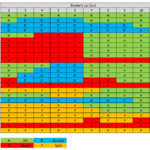 If you have never played Blackjack before, including online, or if you are not sure exactly when to hit, stand, double down, or split, we can help. There is a chart out there that is well known, and legal, that simplifies things for the beginner or person who is not sure when to make certain moves. We can’t go into every detail of the chart, but we highly recommend that you learn it before you start playing. Basically it allows you to have the best chance to win, especially in the long run, when playing against the house. Blackjack, like all table games, is a game of percentages where the house has an advantage in the long run. By playing the “correct” way you can lower those percentages in blackjack to around a 1.5% house advantage. This is one of the lowest house percentage for the house in all their table games.
 Play
Play